

Training for Clinicians
Support treatment by supporting clinicians
Clinical trainings brought to you by The Be Center are steeped in evidence-based practices, guided by professionals with extensive training and experience in the field. Our clinical training programs are grounded in research, designed to challenge clinicians and expand their knowledge base. The core of the work we do is rooted in Dialectical Behavioral Therapy and how this treatment is being used and adapted in other areas to better lives, and improve mental health treatment. We invite you to explore the training options we offer, many available at your own pace, with others being live, many with Continuing Education Units (CEUs) provided. We also provide private trainings for programs, schools, and organizations.

DBT with Couples:
A Comprehensive Clinical Training
July 17 & July 31, 2026
11:00 AM – 4:30 PM ET
10 CE Hours | Live Virtual Training.
Brought to you by Dr. Lucy Payne and The Be Center
This intensive two-day training is designed for clinicians who already have a foundation in DBT and want to extend that expertise into couples work. No prior experience with couples therapy is required.
Grounded primarily in Fruzzetti’s framework for DBT couples and family assessment and intervention, and informed by current empirical research, this training provides a comprehensive roadmap for applying DBT to couples experiencing emotional dysregulation, chronic conflict, invalidation, and relationship distress.
Participants will learn how to:
Conceptualize couple functioning using the transactional model
Conduct comprehensive couples-specific assessment
Apply DBT treatment hierarchy in the treatment of couples
Build and maintain commitment to treatment
Use both individual and relationship-specific DBT skills to reduce conflict and increase closeness
Session management, managing and preventing escalation and therapy-interfering behavior
Integrate couples work as an adjunct to individual DBT treatment when relationship dysfunction is contributing to treatment targets
Implement practical interventions that can be immediately applied in clinical practice
The training combines didactic instruction, live demonstrations and role plays, and interactive discussion to help clinicians develop both a strong conceptual understanding of DBT couples treatment and the confidence to begin using these strategies in their own work.
Space is limited.
Bringing Parents Into Treatment:
Part 1:The DBT for Parents Model
A clinician-focused training that equips you with the framework, skills, and confidence to meaningfully involve parents in treatment — and transform outcomes for the whole family.
🎓4 CE Credits 💻Self-Paced Format 📋Evidence-Based Framework
Presented by Luciana Payne, PhD & Daniel Crump LICSW
The Gap We're Addressing
Clinicians are trained to treat individuals.
Parents are often left out of the picture.
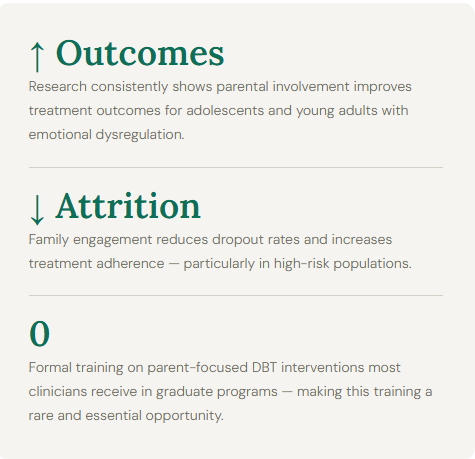
Most clinicians receive little formal guidance on how to effectively work with parents — and without a structured approach, their involvement in treatment can range from peripheral to counterproductive.
Yet the research is clear: parents are not bystanders. Family transactions play a direct role in maintaining or intensifying emotional and behavioral dysregulation in adolescents and young adults. When parents are left unsupported, even excellent individual treatment can stall.
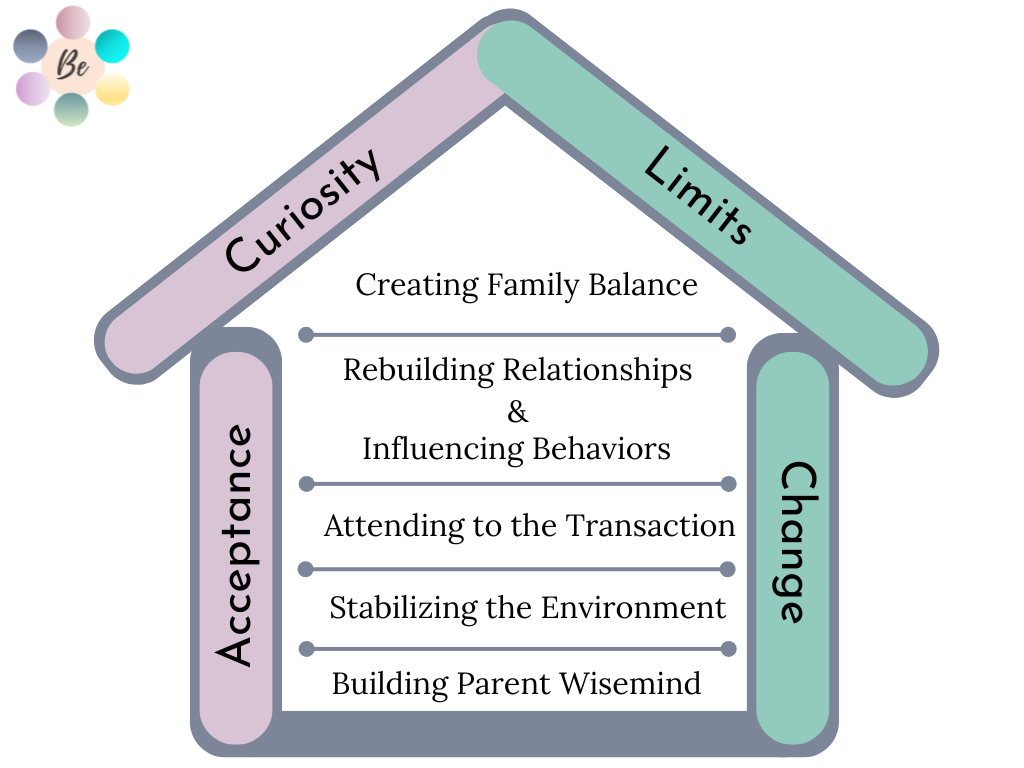
The DBT for Parents model was developed to fill exactly this gap. It offers clinicians a structured, full model and evidence-based framework for assessing parent behaviors, understanding their impact on treatment, and intervening in targeted, effective ways — directly integrating parent work into your DBT treatment plan.
This training will give you the conceptual foundation and practical tools to engage parents with clarity and confidence — and to do so in a way that directly enhances your client's progress
What You Will Learn
The Case for Parent Involvement
Identify the key clinical and research-supported reasons why actively involving parents is essential in treating adolescents and young adults — and why it cannot be an afterthought.
Family Transactions & Dysregulation
Understand how reciprocal family patterns can maintain or exacerbate emotional and behavioral dysregulation in youth — and how to conceptualize these dynamics from a DBT framework.
Parent-Focused Chain Analysis
Conduct a structured chain analysis adapted specifically for parent behaviors — enabling you to assess contributing factors, identify intervention targets, and guide treatment planning.
DBT Skills for Parents
Utilize key DBT-based strategies developed specifically to support and engage parents — including a hierarchy of parent-focused interventions you can apply across treatment contexts.
Apply DBT-based strategies specifically adapted for parent work
Our DBT for Parents Training is a 3-part comprehensive treatment model. Full Comprehensive Training coming in November of 2026.
Training Overview
A Practical Framework,
Grounded in Evidence
This is not a theoretical overview. This training gives you a structured, usable model you can integrate immediately into your clinical work — with parents across outpatient, intensive, and community settings.
Why parent involvement is a clinical imperative — not a nice-to-have
How to assess and understand parent behavior through a DBT lens
The role of family transactions in maintaining dysregulation
Parent-focused chain analysis: a step-by-step clinical tool
DBT-based skills specifically adapted for a parent population
A hierarchy of parent-focused interventions with clear clinical logic
Deepened understanding of family dynamics in high-emotion households
Expanded clinical toolkit applicable across treatment modality
Led by Specialists in DBT and Family Work

Daniel Crump, LICSW
Licensed Independent Clinical Social Worker
Daniel Crump is a seasoned DBT clinician with specialized expertise in working with adolescents, young adults, and their families. His clinical work integrates standard DBT with parent-focused interventions, and he brings a practical, case-informed perspective to training — grounding theory in real treatment challenges clinicians face every day.

Luciana Payne, PHD
Licensed Psychologist · FL & MA
Dr. Payne is a co-founder and clinical director of The BE Center, where she specializes in DBT for parent populations. With extensive experience across outpatient, intensive, and residential settings, her clinical focus sits at the intersection of evidence-based practice and family systems. She brings both rigorous training and deep practical experience to this model.
What to Expect
🎓 CE Credits: 4 Credit Hours 💻 Format: Live Recording 👥 Audience: Licensed Clinician
📚 Level: Intermediate 🏛 Provider: The Be Center
Questions?
Evidence Base
Selected References
This training is grounded in peer-reviewed research on DBT, family systems, and parent-focused interventions.
Payne, L.G. & Fruzzetti, A.E. (in review). The Impact of a Brief, Intensive DBT Parent Skills Program on Adolescent Treatment Outcomes and Family Functioning: A Randomized Trial.
Fruzzetti, A. E., & Payne, L. G. (2020). Assessment of parents, couples, and families in dialectical behavior therapy. Cognitive and Behavioral Practice, 27(1), 39–49. doi.org/10.1016/j.cbpra.2019.10.006
Fruzzetti, A. E. (2017). Dialectical behaviour therapy with parents, couples, and families to augment Stage 1 outcomes. In The Oxford Handbook of Dialectical Behaviour Therapy. doi.org/10.1093/oxfordhb/9780198758723.013.19
Fruzzetti, A. E., Payne, L. G., & Hoffman, P. D. (2021). DBT with families. In Dialectical Behavior Therapy in Clinical Practice (pp. 366–387).
Zalewski, M., Lewis, J. K., & Martin, C. G. (2018). Identifying novel applications of dialectical behavior therapy: considering emotion regulation and parenting. Current Opinion in Psychology, 21, 122–126. doi.org/10.1016/j.copsyc.2018.02.013
Everett, Y., Lightcap, A., O'Brien, J. R., Weinstein, N. Y., & Zalewski, M. (2024). Integrating dialectical behavior therapy skills and parent training for dually dysregulated parents and children: an idiographic case study. Cognitive and Behavioral Practice. doi.org/10.1016/j.cbpra.2024.04.002
Guillén, V., Fernández-Felipe, I., Marco, J. H., Grau, A., Botella, C., & García-Palacios, A. (2024). "Family Connections," a program for relatives of people with borderline personality disorder: A randomized controlled trial. Family Process, 63(4), 2195–2214. doi.org/10.1111/famp.13089
Berk, M. S., Rathus, J., Kessler, M., Clarke, S., Chick, C., Shen, H., & Llewellyn, T. (2022). Pilot test of a DBT-based parenting intervention for parents of youth with recent self-harm. Cognitive and Behavioral Practice, 29(2), 348–366. doi.org/10.1016/j.cbpra.2020.10.001